
Words matter in LGBTQ+ ministry because the people affected by them are already sitting in our churches, studying in our seminaries, and serving throughout Christian communities.
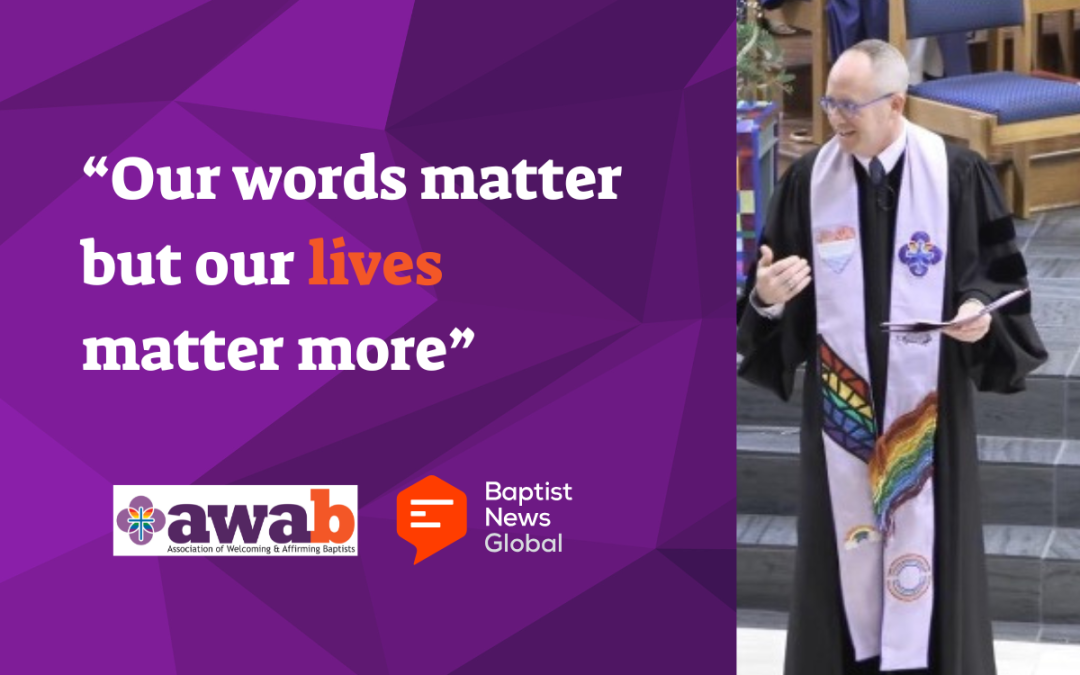
In a new opinion piece for Baptist News Global, AWAB Executive Director Rev. Dr. Brian Henderson reflects on the responsibility Christians carry when speaking about LGBTQ+ people, particularly when we encounter identities or experiences we may not fully understand.
His article, “Our Words Matter but Our Lives Matter More,” responds to a recent reflection from queer Truett Seminary student Jordann McMahan and a subsequent conversation on BNG’s Stuck in the Middle with You podcast.
At the center of Brian’s response is a simple reminder: these conversations are about people.
When Theological Conversations Become Personal
Christians regularly debate questions of sexuality and gender identity. Those conversations may involve Scripture, church policy, or theological conviction.
But Brian reminds readers that LGBTQ+ people are often present while those conversations are taking place.
They may be members of the congregation or students preparing for ministry. Sometimes they are listening while those around them have no idea that the subject being discussed is also their life.
That reality changes the responsibility of the speaker.
Brian writes that “intention does not erase impact.”
A comment intended as humor or an expression of confusion can still communicate that another person’s identity is strange, ridiculous, or unworthy of serious consideration.
For Christians committed to caring for others, that should matter.
“I Don’t Understand” Can Become an Invitation
One of the most important distinctions in Brian’s piece is between admitting that we do not understand something and allowing that lack of understanding to become dismissal.
None of us understands every experience another person brings into our communities.
The question is what we do next.
For Brian, not knowing can become an invitation to listen. It can move us toward learning rather than assuming that another person must make their life easier for us to understand.
That posture is especially important for pastors.
Regardless of where a minister stands theologically on LGBTQ+ inclusion, that minister will provide pastoral care to LGBTQ+ people. Queer people are already members of our churches and families. They are already answering calls to ministry.
Pastors therefore have a responsibility to understand the people entrusted to their care.
Behind Every Letter Is a Life
Brian also challenges the casual dismissal of the LGBTQ+ acronym as confusing or excessive.
Letters are shorthand. People are not.
Behind every identity is a person trying to understand themselves and determine whether a Christian community will receive them with care.
For AWAB, this is part of why welcoming and affirming ministry matters so deeply.
Our work is grounded in the conviction that LGBTQ+ people are created in the image of God and belong fully within the life of the Church. That commitment requires more than welcoming language on a website. It asks us to consider how our words are experienced by the people who hear them.
Choosing Curiosity Over Dismissal
Brian’s article does not suggest that Christians must understand everything before entering into relationship with one another.
Instead, it offers a more faithful starting point.
When another person shares something about who they are that we do not understand, our first response does not have to be dismissal.
We can listen.
We can ask questions with care.
And sometimes the most important thing we can say is simply, “Help me understand.”
That willingness can turn a moment of uncertainty into an opportunity for deeper relationship.
Read Brian’s Full Reflection in Baptist News Global
The Church’s conversations about LGBTQ+ people have consequences far beyond the words themselves.
Brian’s newest BNG opinion invites Christians, pastors, and theological institutions to remember the lives behind those conversations and approach them with greater care.
Because our words matter.
But the lives receiving those words matter even more.